YouTube
 Instagram
 Facebook
 TikTok


When choosing a mechanical watch, what do you look for?
Many of you would probably say "design," "functionality," or "investment value." While appearance and resale value are certainly very important points, I believe that having more knowledge and understanding of the brand and model's historical background, as well as the minor changes made over the years, can make you love watches even more and enjoy the process of choosing one. In this column, we will thoroughly dissect and explain as much as we can about mechanical watches, for both beginners and advanced enthusiasts, to help you in your watch selection.
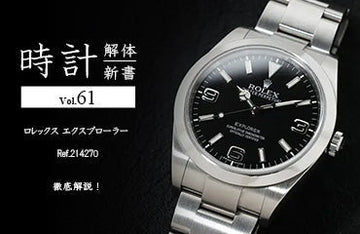
This time, we will focus on the [Rolex] 'Explorer' "Ref. 1016 (matte dial)," so please read on to the end.
[ROLEX] 'EXPLORER' "REF. 1016"
Born in 1953, it has long been loved as a prime example of a "tool watch" for its simple three-hand design and high durability. Among them, the "Ref. 1016" was a long-selling model manufactured for approximately 30 years, with the dial transitioning from gilt (glossy) in the first half to matte (non-glossy) in the latter half.
This time, we will focus on the matte dial period and explain it in detail!
BASIC SPECS
Year of manufacture: Early 1960s - 1989 (this article covers the matte period: approx. 1968 - early 1990s)
Case size: 36mm
Bezel: Smooth bezel
Crystal: Plastic
Water resistance: 100m
Movement: "Cal. 1560" → "Cal. 1570 (transitioned to include hacking function)"
① DIAL
Matte dials show subtle changes in font, coronet, and the 6 o'clock inscription over time.
■DIAL FROM AROUND 1968-1973 (COMMONLY KNOWN AS “FROGFEET”)

Features at 12 o'clock
・The coronet mark is horizontally wide, resembling a frog's foot. The horizontal bar in the middle of the "E" in the ROLEX logo has no serifs.
Key point to remember
・Coronet mark = frog's foot.
Supplement (Fat Font)

・Dials with thicker Arabic numeral indices than usual existed in the very early period.
・Also rarely seen on the final dial, referred to as "Fat Luminous."
■ DIAL FROM AROUND 1968-1969

Features at 12 o'clock
・Well-balanced coronet mark / The horizontal bar in the middle of the "E" in the ROLEX logo has serifs.
Features at 6 o'clock
・The "SWISS - T < 25" inscription is printed slightly inside the dial's outer edge, closer to the 6 o'clock index.
・It inherits some characteristics of the mirror dial, with the coronet mark, lettering, and minute track all printed in white.
Key point to remember
・Neat layout unique to the transition period (pay attention to the coronet and serifs on the "E").
■DIAL FROM AROUND 1974-1976

Features at 12 o'clock
・The ROLEX logo changed from a Gothic style to a Century style typeface, giving it a modern impression.
・The other two lines also have serif fonts.
Features at 6 o'clock
・The chronometer inscription is bold and has serifs, giving it a powerful impression.
Key point to remember
・All 12 o'clock fonts have serifs.
・Similar to the final version, but tritium burn tends to be strong in this era.
・*Also said to have been used as a service dial.
■DIAL FROM AROUND 1976-1979 (COMMONLY KNOWN AS “TALL CROWN”)

Features at 12 o'clock
・The ROLEX logo uses a Century-style font.
・The most distinguishing feature is the vertically elongated coronet mark (Tall Crown).
Features at 6 o'clock
・The chronometer inscription, like the coronet mark, has a vertically elongated font nuance.
Key point to remember
・Vertically elongated coronet mark = Tall Crown.
・A rare dial with fewer existing examples despite being from the early period of circulation.
■DIAL FROM AROUND 1981-1985

Features at 12 o'clock
・The ROLEX logo is a slightly thicker Century-style font.
・The coronet has a hand-drawn feel.
Features at 6 o'clock
・The letters in "SWISS" are close together.
Key point to remember
・Thicker logo + hand-drawn style coronet is the key.
・Many individuals show signs of aging (burn) and can resemble service dials, so caution is advised.
■DIAL FROM AROUND 1986-1990

Features at 12 o'clock
・The coronet mark and the three lines of lettering are very similar, making differentiation difficult.
Features at 6 o'clock
・The chronometer inscription and SWISS inscription show the same tendencies as Type 2.
Key point to remember
・Popular as the final dial for Ref. 1016.
・The luminous material tends to show less discoloration, and many examples from this period are in good condition.
② BRACELET
The bracelets fitted to "Ref. 1016" changed as follows over the years. Matching this with the dial period can also serve as a guide for determining whether it's an original specification or a service replacement.
■Rivet bracelet: ~Early 1970s
■Folded bracelet: Early to late 1970s
■Solid link bracelet: Late 1970s - 1980s
※The above is a guideline. Actual pieces may vary depending on the region of shipment and service history. It is safest to make a comprehensive judgment by looking at the combination of case serial / clasp code / end links.
SUMMARY
The biggest appeal of the matte dial period of the 'Explorer' "Ref. 1016" is the clear distinguishing points due to subtle changes in font, coronet, and 6 o'clock markings.
Among them, the "Frogfoot" and "Tall Crown" have strong individuality, stimulating collectors' desires.
On the other hand, the coexistence of service dials and the consistency with the bracelet are important factors that influence evaluation. Since original pieces in good condition are becoming rarer each year, it is recommended to compare details in images and check the actual watch thoroughly to secure a satisfactory piece early on.
We will continue to research the "Ref. 1016" matte period and update information, so please look forward to the next article!
See you next time!